Quick Answer
If you’re asking what equipment should a food worker use to reheat a baked potato, the best answer is generally a commercial oven, convection oven, or microwave oven capable of reheating the potato rapidly to the required internal temperature.
For a cooked and cooled food being reheated for hot holding under the FDA Food Code, all parts of the food generally need to reach 165°F (74°C) for at least 15 seconds, and reheating must be completed rapidly—within two hours. When a microwave is used for reheating food for hot holding, the food must reach 165°F, be covered, and stand covered for two minutes after reheating. What equipment food worker reheat baked potato.
A steam table, hot-holding cabinet, or warming unit should not normally be treated as the primary reheating appliance. Those units are designed mainly to maintain food at a safe hot-holding temperature after proper reheating, rather than bring refrigerated food rapidly through the temperature range where bacterial growth can occur.
That distinction—reheating equipment versus hot-holding equipment—is the key to answering this common food-handler question correctly.
Why the Equipment Used for Reheating Matters
A baked potato looks simple. It has one ingredient, requires little preparation, and seems easy to warm up.
In a commercial kitchen, though, reheating isn’t simply about making food feel warm.
A food worker needs to consider:
- how the potato was originally cooked;
- how it was cooled;
- how long it has been refrigerated;
- whether it will be served immediately or held hot;
- the reheating equipment being used;
- the temperature at the center of the potato;
- the time required to reach that temperature;
- local food-code requirements; and
- whether the potato was stored in aluminum foil.
These details matter because temperature control is one of the basic tools used to reduce foodborne-illness risk.
The FDA identifies approximately 41°F to 135°F (5°C to 57°C) as the temperature range in which TCS foods require careful control. Food workers therefore try to minimize the amount of time appropriate foods spend within this range.
That is why commercial kitchens need equipment capable of heating food effectively and predictably.
What Equipment Should a Food Worker Use to Reheat a Baked Potato?
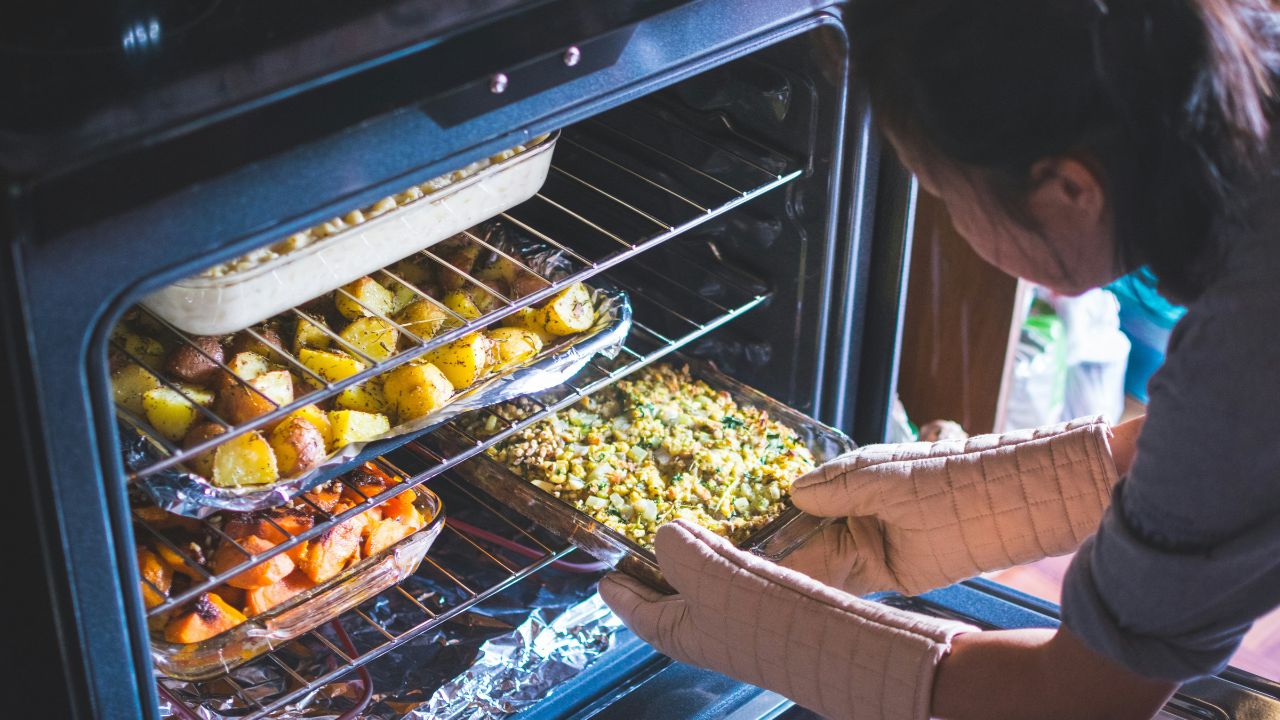
For most food-service situations, a food worker should use equipment designed for rapid reheating, such as a commercial oven, convection oven, or microwave oven.
The exact choice depends on the number of potatoes, desired texture, kitchen workflow, manufacturer instructions, and applicable food-safety rules.
A conventional or convection oven works particularly well when reheating multiple potatoes because it provides controlled heat around the food.
A microwave can be useful when reheating one or a few potatoes quickly.
Whatever appliance is selected, workers shouldn’t rely on the appliance setting, cooking time, appearance, or touch alone to decide whether the potato has reached its required temperature.
A calibrated food thermometer should be used to verify the internal temperature when required.
FDA inspection guidance specifically says reheating compliance should be based on actual temperature measurements using a calibrated food-temperature measuring device rather than relying only on conversations with cooks or managers.
This means the complete practical answer to what equipment should a food worker use to reheat a baked potato includes two pieces of equipment:
A suitable reheating appliance plus an accurate food thermometer.
Best Equipment for Reheating Baked Potatoes
Not every piece of kitchen equipment serves the same purpose. Understanding what each appliance actually does makes the choice much easier.
| Equipment | Suitable for Reheating? | Best Application | Main Consideration |
|---|---|---|---|
| Commercial oven | Yes | Multiple baked potatoes | Slower but consistent |
| Convection oven | Yes | Batch reheating | Fast, even circulating heat |
| Microwave oven | Yes | Small quantities | Fast but requires correct microwave procedure |
| Combi oven | Yes | High-volume commercial kitchens | Precise commercial control |
| Steam table | Generally not for primary reheating | Hot holding | Designed primarily to maintain temperature |
| Hot-holding cabinet | Generally not for primary reheating | Holding reheated food | Best after proper reheating |
| Heat lamp | No | Short-term temperature support for suitable foods | Doesn’t rapidly heat the center |
| Food thermometer | Verification tool | Checking internal temperature | Essential for temperature verification |
Let’s look more closely at the practical differences.
1. Commercial Oven
A commercial oven is one of the most dependable options for reheating baked potatoes.
Unlike a hot-holding appliance, an oven produces enough active heat to raise the internal temperature of refrigerated food efficiently.
It also works well for batch production.
Imagine a restaurant preparing 40 baked potatoes for dinner service. Some remain after the first service period and are properly cooled and refrigerated according to the establishment’s food-safety procedures.
If those potatoes are later approved for reheating, an oven can heat a large batch at once.
The kitchen worker should still verify temperatures rather than assuming that every potato has heated equally.
Large potatoes may take longer than smaller ones, and differences in refrigerator temperature, oven loading, placement, and potato size can affect reheating.
Advantages of a Commercial Oven
A commercial oven provides:
- controlled heating;
- good capacity;
- consistent results;
- practical batch reheating;
- good texture; and
- compatibility with many commercial kitchen workflows.
The dry heat can also help preserve the characteristic texture people expect from a baked potato.
2. Convection Oven
A convection oven is another strong choice.
It uses a fan to circulate heated air throughout the oven cavity. That circulation can improve heat distribution and often speeds up cooking and reheating compared with a conventional oven.
This can be useful in busy restaurants, cafeterias, schools, hotels, catering kitchens, and institutional food-service operations.
The worker should avoid overcrowding trays because airflow matters.
Packing potatoes tightly together may create areas where heat circulation is reduced.
Spacing them appropriately helps the hot air reach more of each potato’s surface.
Why Convection Works Well
A convection oven for reheating baked potatoes offers a useful combination of:
- capacity;
- speed;
- texture;
- heat circulation; and
- operational efficiency.
Even so, airflow doesn’t replace temperature verification.
A thermometer provides the evidence that the center of the food has reached the required temperature.
3. Microwave Oven
A microwave oven can be an excellent option when speed matters.
Instead of waiting for an entire conventional oven to heat, a food worker can reheat individual potatoes or small batches quickly.
Microwave heating, however, can be uneven.
One section can become extremely hot while another remains cooler.
That is why checking temperature in an appropriate location is important.
Under FDA Food Code provisions for TCS food reheated in a microwave for hot holding, all parts must reach at least 165°F (74°C). The food must also be covered and allowed to stand covered for two minutes after reheating.
So microwave reheating baked potatoes can be safe and efficient when workers follow the correct procedure.
It shouldn’t be treated as simply:
“Microwave until it feels hot.”
The required process and temperature verification still matter.
4. Combi Oven
Large professional kitchens may have a combi oven.
A combi oven can use dry heat, steam, or combinations of the two, giving kitchen staff more control over cooking conditions.
For facilities preparing hundreds of meals, this versatility can make a combi oven valuable for reheating.
Hotels, hospitals, universities, catering operations, banquet kitchens, and large cafeterias frequently use commercial equipment because high-volume service demands predictable results.
A properly programmed combi oven may provide excellent temperature control and consistency.
Still, workers must follow:
- the establishment’s approved procedure;
- equipment manufacturer instructions;
- food-safety plans;
- thermometer verification requirements; and
- applicable local regulations.
Technology assists the worker. It doesn’t replace safe food handling.
Why a Steam Table Is Usually the Wrong Answer
This is where many food-handler questions become confusing.
A steam table gets hot.
So why shouldn’t a food worker simply place a refrigerated baked potato in the steam table and wait for it to become hot?
Because reheating and hot holding are different processes.
A steam table is primarily intended to keep already-hot food at a safe holding temperature.
It may not bring cold food through intermediate temperatures rapidly enough.
FDA Food Code guidance requires qualifying TCS food that has been cooked, cooled, and reheated for hot holding to be brought to its required reheating temperature rapidly. The time between 41°F and the specified reheating temperature cannot exceed two hours.
This makes steam table vs oven reheating an important food-safety distinction.
Think of It This Way
Oven = reheat.
Steam table = hold hot.
That’s a simplified memory aid rather than a substitute for local procedures, but it explains the fundamental difference.
A kitchen may use an oven first and transfer the fully reheated food to approved hot-holding equipment afterward.
Hot-Holding Cabinets Aren’t the Same as Reheating Equipment
A hot-holding cabinet serves a similar role.
Its purpose is normally to maintain prepared foods at controlled serving temperatures.
Some modern commercial equipment may have specialized reheating functions. If a manufacturer has specifically designed and approved equipment for rapid reheating, workers should follow its operating instructions and the establishment’s food-safety procedures.
But a conventional warming cabinet shouldn’t automatically be assumed to be an acceptable reheating appliance.
The question should always be:
Can this equipment raise the food to the required temperature within the required time?
If not, choose proper reheating equipment.
The Food Thermometer: The Tool Workers Shouldn’t Forget
A thermometer doesn’t generate heat, but it’s one of the most important pieces of equipment in the process.
A potato can look steaming hot outside while remaining cooler in its center.
Human hands cannot accurately distinguish between temperatures such as 140°F, 155°F, and 165°F.
That’s why professional kitchens use temperature-measuring devices.
A calibrated food thermometer allows a worker to check rather than guess.
FDA inspection procedures specifically emphasize actual product temperature measurements when evaluating proper reheating.
How to Check a Baked Potato
Insert an appropriate clean and sanitized thermometer probe into the thickest portion of the potato.
Avoid checking only the surface.
For batches containing potatoes of different sizes, checking representative items—particularly larger or potentially slower-heating ones—can provide better information, subject to the establishment’s required procedure.
After use, clean and sanitize the probe according to workplace procedures.
That prevents the thermometer itself from becoming a source of cross-contamination.
Understanding the 165°F Reheating Rule
One of the most important numbers associated with commercial reheating is 165°F (74°C).
Under the FDA Food Code, TCS food cooked, cooled, and then reheated for hot holding generally must reach at least 165°F throughout for 15 seconds.
This isn’t the same as saying every leftover food eaten in every circumstance must always follow precisely the same commercial hot-holding rule.
Context matters.
Food-code requirements can differ depending on:
- whether food is reheated for immediate service;
- whether it will enter hot holding;
- whether it was commercially processed;
- the type of food;
- the establishment’s jurisdiction; and
- applicable state or local regulations.
For example, the FDA Food Code specifies a different provision for certain commercially processed and packaged ready-to-eat TCS foods being reheated for hot holding: those foods may be heated to at least 135°F (57°C).
That distinction is why food workers should follow their manager’s approved food-safety procedures rather than memorizing a single number and applying it to every situation.
Why Reheating Must Be Rapid
Temperature isn’t the only issue.
Time matters too.
The FDA identifies 41°F to 135°F as the typical temperature danger zone for TCS foods.
When food moves slowly through this range, microorganisms may have more opportunity to multiply.
The goal of rapid reheating is to move appropriate foods through intermediate temperatures efficiently.
For food being reheated for hot holding under the FDA rule discussed above, the process from 41°F to the required reheating temperature may not exceed two hours.
This explains why weak warming equipment is a poor choice.
The problem isn’t simply that reheating takes longer.
Slow reheating may conflict with the time-temperature control required for food safety.
Reheating vs. Hot Holding: A Critical Difference
Food workers sometimes treat these terms as interchangeable.
They’re not.
Reheating
Reheating means increasing previously cooked and cooled food from refrigerated temperature to an appropriate serving or hot-holding temperature.
Equipment may include:
- commercial ovens;
- convection ovens;
- microwave ovens; and
- approved combi ovens.
Hot Holding
Hot holding means maintaining food that is already hot at an appropriate temperature before service.
Equipment may include:
- steam tables;
- warming cabinets;
- hot boxes;
- heated serving stations; and
- other approved holding equipment.
The easiest operational principle is:
Reheat quickly first; hold safely second.
Safe Baked Potato Reheating Procedure in a Commercial Kitchen
An establishment’s written procedures and local regulations always take priority, but the general workflow looks like this.
Step 1: Confirm the Potato Was Stored Safely
Before reheating anything, determine whether it was cooled and refrigerated according to required procedures.
Reheating cannot undo every problem caused by improper storage.
FDA guidance for cooked TCS food calls for cooling from 135°F to 70°F within two hours, then from 70°F to 41°F or lower within a total cooling period of six hours.
A food worker shouldn’t assume that unsafe food becomes acceptable merely because it is reheated.
Step 2: Select Proper Reheating Equipment
Use a suitable appliance such as:
- a commercial oven;
- convection oven;
- microwave oven; or
- approved commercial reheating equipment.
Don’t automatically use the steam table because it’s convenient.
The appliance must be capable of bringing the food to its target temperature rapidly enough.
This is the central principle behind choosing safe reheating equipment.
Step 3: Prepare the Potato According to Workplace Procedures
Place the potato in the appropriate food-safe pan, tray, or microwave-safe container.
Follow the appliance manufacturer’s instructions.
Pay special attention to any packaging or wrapping around the potato.
Metal foil, for example, should not be put into an ordinary microwave unless the appliance manufacturer specifically permits a particular use.
In commercial kitchens, workers should follow the establishment’s approved method rather than improvising.
Step 4: Reheat Rapidly
Start reheating with equipment that provides sufficient heat.
Avoid setting refrigerated food into a low-temperature holding unit and waiting for it to warm slowly.
For qualifying cooked and cooled TCS food reheated for hot holding, FDA rules require the process to reach the required temperature within two hours.
Step 5: Measure the Internal Temperature
Use a food thermometer.
Insert the sanitized probe into the thickest part of the potato.
For the FDA hot-holding scenario described above, confirm the food has reached 165°F for 15 seconds.
Don’t rely solely on:
- steam;
- smell;
- skin temperature;
- cooking time;
- oven temperature; or
- visual appearance.
These observations cannot accurately tell you the potato’s internal temperature.
Step 6: Follow Microwave-Specific Requirements
When a microwave is used for TCS food being reheated for hot holding, FDA guidance requires the food to reach 165°F throughout.
It must also be covered and then allowed to stand covered for two minutes after reheating.
The standing period helps heat distribute through the food.
This is particularly relevant to dense foods where microwave energy may not heat every area identically.
Step 7: Transfer to Hot Holding When Appropriate
Once properly reheated, the baked potato can be moved to the establishment’s approved hot-holding equipment when it isn’t being served immediately.
This is when a steam table or heated cabinet becomes useful.
The equipment is now maintaining heat rather than trying to create the rapid temperature increase needed during reheating.
Oven vs. Microwave for Reheating Baked Potatoes
Both can work, but they serve slightly different operational needs.
| Factor | Commercial Oven | Microwave |
|---|---|---|
| Speed | Moderate | Very fast |
| Batch capacity | Excellent | Limited |
| Texture | Generally better | May soften skin |
| Even heating | Usually good | Can create uneven heating |
| Small orders | Less efficient | Excellent |
| Large-volume service | Excellent | Less practical |
| Temperature verification | Required as applicable | Required as applicable |
| Special FDA hot-holding procedure | Standard reheating rules | Cover/stand requirements apply |
For a restaurant reheating 20 potatoes before service, an oven may make more operational sense.
For a café reheating one potato for an individual order, a microwave may be more efficient.
Neither option eliminates the need for proper temperature control.
Why Heat Lamps Aren’t Reheating Equipment
A heat lamp makes food surfaces warm.
That doesn’t mean it can rapidly heat the center of a cold baked potato.
A baked potato is dense and relatively thick. Surface heat needs time to move inward.
Using a heat lamp to reheat food may leave the center too cool while drying or overheating the exterior.
Heat lamps are generally associated with maintaining serving conditions for appropriate already-hot foods rather than reheating refrigerated foods.
A food worker should use equipment specifically suited to the actual task.
A Real-World Restaurant Example
Consider a casual restaurant that serves baked potatoes with grilled meals.
During lunch, the kitchen prepares 30 potatoes. Several remain unused.
The restaurant follows its approved cooling procedures and stores suitable leftovers under refrigeration.
Before dinner service, the kitchen needs another batch.
Poor Approach
An employee places cold potatoes directly into a warming cabinet.
After an hour, the outside feels warm, so the employee assumes they’re ready.
The problem is obvious from a food-safety standpoint: nobody has verified the internal temperature, and the equipment may not have heated the potatoes rapidly enough.
Better Approach
The employee places the potatoes in an approved commercial oven according to the restaurant’s reheating procedure.
The worker checks the thickest portions with a calibrated thermometer and confirms the required internal temperature has been reached.
The potatoes can then move into approved hot-holding equipment.
This approach separates three functions clearly:
Refrigeration → Rapid reheating → Hot holding
That workflow is easier to monitor and considerably more reliable than guessing.
Why Baked Potatoes Need Special Attention
Potatoes deserve a little more attention than their simple appearance suggests.
One particular issue is baked potatoes stored in foil.
Low-oxygen environments are relevant to Clostridium botulinum, the bacterium associated with botulism. USDA food-safety resources identify Clostridium botulinum as a serious foodborne hazard and note its association with environments where adequate safety controls are absent.
The practical lesson for commercial workers isn’t to become microbiologists.
It’s to follow established procedures for:
- cooking;
- foil handling;
- cooling;
- refrigeration;
- reheating; and
- hot holding.
Never assume wrapping a potato keeps it safe indefinitely.
Temperature and storage procedures still matter.
Common Reheating Mistakes Food Workers Should Avoid
Using a Steam Table to Reheat Cold Food
This is one of the most common conceptual errors.
A steam table is principally a hot-holding appliance, not a substitute for equipment designed to rapidly reheat refrigerated food.
Use proper reheating equipment first.
Checking Temperature by Touch
Hands aren’t thermometers.
A potato that feels hot on the outside may have a cooler center.
Use an appropriate calibrated food thermometer.
Checking Only One Convenient Spot
Heat distribution can vary.
Probe the thickest portion and follow the establishment’s sampling procedure when working with batches.
Overcrowding an Oven
Putting too many potatoes together can interfere with airflow and heat distribution, particularly in convection equipment.
Arrange batches according to the equipment’s operating instructions.
Reheating Too Slowly
A low setting may appear gentler on food quality, but commercial reheating for hot holding has a time requirement.
Use equipment capable of rapid heating.
Assuming Reheating Fixes Improper Cooling
It doesn’t.
Food that hasn’t been stored according to required food-safety controls should be handled according to the establishment’s corrective-action policy.
Workers should never attempt to “save” questionable food simply by making it very hot.
Equipment Selection by Food-Service Environment
Different businesses may choose different tools.
Restaurant Kitchen
A full-service restaurant commonly has:
- commercial ranges;
- convection ovens;
- microwaves;
- combi ovens;
- warming cabinets; and
- steam tables.
For batch reheating, the oven or combi oven often makes practical sense.
School Cafeteria
A cafeteria may prepare hundreds of meals.
Batch capacity becomes especially important.
A commercial convection or combi oven can allow workers to process multiple trays while maintaining a standardized procedure.
Temperature logs may also form part of the facility’s food-safety management system.
Convenience Store
A small convenience operation may rely heavily on microwave equipment.
A commercial microwave can be appropriate when used according to food-safety requirements and manufacturer instructions.
Workers still need to distinguish between reheating for immediate service and reheating for hot holding.
Catering Operation
Caterers deal with transportation as well as preparation.
This adds another temperature-control challenge.
The kitchen may reheat potatoes in commercial ovens and then transfer them to approved insulated or heated holding equipment for transport and service.
Time-temperature monitoring becomes particularly important when food moves between facilities.
Hospital or Institutional Kitchen
Institutional kitchens often have highly standardized procedures because consistency is important.
Workers may use combi ovens, commercial ovens, temperature-monitoring systems, and detailed production logs.
The underlying principle remains the same: use equipment capable of rapid, controlled reheating and verify temperatures.
The Role of HACCP and Food-Safety Systems
Many professional food operations use principles associated with HACCP, or Hazard Analysis and Critical Control Point.
HACCP focuses on identifying hazards and controlling them at specific stages of food production.
For baked potatoes, a simplified process might look like:
Receiving → Storage → Preparation → Cooking → Holding → Cooling → Refrigerated storage → Reheating → Hot holding → Service
Temperature problems can occur at several points.
That is why reheating shouldn’t be viewed in isolation.
Excellent reheating equipment cannot compensate for serious mistakes earlier in the food’s history.
A well-run kitchen thinks about the entire process.
Food Thermometer Best Practices
Owning a thermometer isn’t enough.
Workers need to use it properly.
Keep It Clean
A probe touching food can transfer contamination from one product to another.
Clean and sanitize it according to the establishment’s procedure before and after appropriate uses.
Check the Correct Area
For a baked potato, the center or thickest area is usually the most informative place to verify internal temperature.
Calibrate as Required
Thermometers can lose accuracy.
Commercial establishments should follow their procedures and manufacturer recommendations for calibration or accuracy checks.
Record Temperatures When Required
Some operations maintain logs for:
- cooking;
- cooling;
- refrigeration;
- reheating; and
- hot holding.
Documentation can help managers identify recurring problems before they become larger food-safety issues.
Food Safety Isn’t Just About Reheating Temperature
A common mistake is focusing entirely on the number 165°F.
Temperature is important, but safe food handling is a system.
A properly reheated potato can still become contaminated afterward.
Food workers also need good practices involving:
- clean hands;
- clean utensils;
- sanitized food-contact surfaces;
- appropriate storage;
- separation from contamination sources;
- temperature-controlled holding; and
- correct service practices.
This broader approach reduces foodborne-illness risk far more effectively than treating reheating as an isolated step.
Commercially Processed Food vs. Food Cooked On-Site
Another distinction frequently missed in basic explanations concerns commercially processed foods.
The FDA Food Code distinguishes between TCS food cooked and cooled on the premises and certain commercially processed, packaged ready-to-eat foods.
Food cooked, cooled, and reheated for hot holding on-site generally follows the 165°F for 15 seconds reheating requirement.
Certain commercially processed and packaged ready-to-eat TCS foods being reheated for hot holding have a minimum reheating temperature of 135°F under the Food Code.
This distinction reinforces an important lesson:
Identify the food and process before selecting a temperature rule.
Food workers should use the procedure established for the specific product rather than applying a memorized rule without context.
Reheating for Immediate Service vs. Hot Holding
The phrase “reheat a baked potato” can describe different situations.
Suppose a customer orders a potato and the kitchen reheats it specifically for that customer.
Now compare that with reheating 30 refrigerated potatoes and putting them into a heated cabinet for two hours of dinner service.
Those aren’t operationally identical scenarios.
The FDA Food Code section discussed throughout this guide specifically addresses reheating for hot holding.
Workers should therefore understand the intended use of the reheated product.
This nuance is often missing from short food-handler answers.
Which Equipment Gives the Best Potato Quality?
Food safety comes first, but restaurants also care about quality.
Different appliances produce different results.
Conventional Oven
Often preserves a pleasant baked texture but requires more time.
Convection Oven
Provides efficient heat circulation and can produce consistent results across batches.
Microwave
Extremely fast, but the potato skin may become softer and heating can be less uniform.
Combi Oven
Provides extensive control and can be especially useful in high-volume commercial environments.
For large batches, convection oven reheating is often an attractive balance between capacity, texture, and speed.
For individual orders, microwave reheating may be more practical.
How Managers Can Improve Reheating Consistency
Food safety improves when workers don’t have to improvise.
A kitchen manager can create a simple standard operating procedure covering:
- approved products for reheating;
- approved equipment;
- batch size;
- appliance settings;
- maximum reheating time;
- required internal temperature;
- thermometer placement;
- corrective action;
- hot-holding procedure; and
- documentation requirements.
This turns reheating from guesswork into a repeatable process.
For example, instead of telling an employee, “Get these potatoes hot,” the procedure could identify the approved oven, batch arrangement, required target temperature, verification method, and next holding step.
That is far more useful to a new employee.
Advanced Insight: Equipment Temperature Is Not Food Temperature
This concept deserves special attention.
Suppose an oven display says 350°F.
That does not mean the potato is 350°F.
The display represents the oven environment or control setting—not the internal temperature of the food.
Similarly, a steam table set to a certain temperature doesn’t prove that a cold potato placed inside has reached a safe internal temperature.
Food workers need to separate three measurements:
Appliance setting → Environmental temperature → Internal food temperature
The third measurement determines what is happening inside the food.
That’s why a thermometer remains necessary even when a sophisticated commercial oven displays a precise temperature.
Advanced Insight: Batch Size Changes Reheating Performance
A procedure that works for five potatoes may not work identically for 50.
Why?
Because adding more cold food increases the thermal load on the appliance.
A heavily loaded oven can:
- recover temperature more slowly;
- experience reduced airflow;
- create inconsistent heating;
- increase reheating time; and
- make cold spots more likely.
Commercial kitchens should validate procedures using realistic batch sizes.
This is especially important in institutional kitchens and catering operations where volume can change dramatically from one service period to another.
Advanced Insight: Potato Size Matters
Not all baked potatoes are identical.
A 6-ounce potato and a 14-ounce potato will not necessarily heat at the same rate.
Larger potatoes generally require more energy and time for heat to reach their centers.
This means standardized purchasing can indirectly improve food-safety consistency.
If a restaurant buys potatoes within a narrow size range, workers can create more predictable cooking and reheating procedures.
That connection between ingredient specification and food safety is rarely discussed, yet it’s highly practical.
Equipment Comparison: Reheating vs. Holding
| Appliance | Produces Rapid Heat | Batch Capacity | Typical Primary Function |
|---|---|---|---|
| Commercial oven | Yes | High | Cooking/reheating |
| Convection oven | Yes | High | Cooking/reheating |
| Microwave | Yes | Low–medium | Rapid cooking/reheating |
| Combi oven | Yes | High | Cooking/reheating |
| Steam table | Limited for this purpose | High | Hot holding |
| Warming cabinet | Limited for this purpose | High | Hot holding |
| Heat lamp | No practical deep reheating | Low | Maintaining surface warmth/serving |
| Thermometer | No | N/A | Temperature verification |
This table explains why the answer isn’t simply “use something hot.”
Equipment must match the food-safety function.
A Simple Memory Rule for Food Workers
Remember these four words:
Heat. Check. Hold. Serve.
Heat: Use proper reheating equipment.
Check: Verify the internal temperature with a calibrated thermometer.
Hold: Move properly reheated food to approved hot-holding equipment when necessary.
Serve: Prevent contamination during final handling and service.
This simple sequence captures the logic of a professional reheating system without requiring employees to remember an entire food-safety textbook during a busy shift.
What Should You Do If the Potato Doesn’t Reach Temperature?
If a food worker checks a potato and it hasn’t reached the establishment’s required reheating temperature, don’t simply transfer it to hot holding.
Continue the approved reheating process if it can still be completed within the applicable time limit and workplace procedure.
If the product has exceeded the permitted time or otherwise falls outside the establishment’s food-safety limits, follow the approved corrective-action policy.
When uncertain, ask the person in charge.
Never guess when food safety is involved.
What About Reheating a Potato More Than Once?
Repeated cooling and reheating creates extra opportunities for time-temperature problems and quality loss.
Commercial establishments should follow their written procedures and applicable local food code concerning leftovers and repeated reheating.
From an operational standpoint, accurate forecasting and smaller batch preparation can reduce unnecessary reheating cycles.
For example, instead of reheating 40 potatoes because dinner service might be busy, a restaurant could reheat smaller validated batches based on demand.
This can improve:
- product quality;
- waste control;
- temperature consistency;
- service efficiency; and
- food-safety management.
Why Local Food Codes Still Matter
The FDA Food Code is a model code.
State, county, city, and other regulatory authorities may adopt particular editions, modify provisions, or establish their own requirements.
The FDA itself describes the Food Code as model requirements designed to help jurisdictions safeguard public health in retail and food-service settings.
That means workers and managers should follow the rules enforced by their actual regulatory authority.
An online guide can explain the general principle, but it doesn’t replace:
- workplace training;
- local health-department requirements;
- certified food-protection manager guidance;
- manufacturer instructions; or
- an establishment’s approved HACCP or food-safety plan.
Frequently Asked Questions
What equipment should a food worker use to reheat a baked potato?
Use equipment capable of rapid reheating, such as a commercial oven, convection oven, microwave, or approved combi oven. For food being reheated for hot holding, verify the required internal temperature using a calibrated food thermometer.
Can you reheat a baked potato in a microwave?
Yes. A microwave oven can reheat a baked potato efficiently. Under FDA rules for TCS food reheated in a microwave for hot holding, the food must reach at least 165°F throughout and be covered and allowed to stand covered for two minutes after reheating.
Can a food worker use a steam table to reheat baked potatoes?
A steam table is generally intended for hot holding rather than rapid reheating. Use appropriate reheating equipment first, verify the required temperature, and then transfer the food to approved hot-holding equipment when needed.
What temperature should a reheated baked potato reach?
For qualifying TCS food that was cooked and cooled on-site and is being reheated for hot holding, the FDA Food Code specifies at least 165°F (74°C) for 15 seconds. Local rules and the specific serving situation should also be considered.
How long can commercial reheating take?
For the FDA hot-holding rule discussed here, qualifying food must move from 41°F to its required reheating temperature within two hours.
Is a heat lamp suitable for reheating a baked potato?
No. A heat lamp isn’t an appropriate primary appliance for rapidly reheating a refrigerated baked potato. It primarily affects the food’s surface and isn’t a dependable way to raise the center rapidly to the required temperature.
Why should a food worker use a thermometer?
A thermometer verifies the internal food temperature. Appearance, steam, appliance settings, and touch don’t provide reliable evidence that the center has reached the required temperature.
Is an oven better than a microwave for baked potatoes?
It depends on the operation. An oven is often better for larger batches and texture, while a microwave is useful for speed and individual portions. Both require proper food-safety procedures.
Should baked potatoes be reheated in aluminum foil?
Follow your establishment’s storage and reheating procedure. Never put ordinary aluminum foil into a microwave unless the microwave manufacturer explicitly permits that specific use. Commercial operations should also pay careful attention to safe handling and storage of foil-wrapped baked potatoes.
Can reheating make improperly stored potatoes safe again?
Workers shouldn’t assume so. Reheating isn’t a universal corrective measure for food that has been improperly cooled, stored, or handled. Questionable food should be handled according to the establishment’s corrective-action and disposal procedures.
Final Takeaway
The equipment question becomes simple once reheating and holding are treated as separate jobs.
A food worker should choose a commercial oven, convection oven, microwave, combi oven, or another appliance specifically approved and capable of rapid reheating. A calibrated food thermometer should then be used to verify that the required internal temperature has been achieved.
For cooked and cooled TCS food being reheated for hot holding, FDA guidance generally calls for 165°F (74°C) for 15 seconds within two hours. Microwave reheating for hot holding also includes covering and a two-minute covered standing period.