Quick Answer: How Does a Water Treatment Plant Work?
If you’re trying to understand how water treatment plant works, picture a carefully controlled cleaning system rather than one giant filter. Raw water enters from a river, lake, reservoir, or underground source and passes through several treatment barriers designed to remove debris, suspended particles, microorganisms, unwanted chemicals, tastes, odors, and other contaminants.
A conventional drinking water treatment plant usually follows this basic sequence:
Source water → screening → coagulation → flocculation → sedimentation → filtration → disinfection → water-quality testing → storage → distribution
The exact process varies. A plant treating relatively clean groundwater may require fewer steps, while a facility treating turbid river water, brackish water, seawater, or recycled water can require much more advanced technology.
That distinction matters because there isn’t one universal recipe for making water safe. Engineers design treatment around the source water, contaminants present, regulatory requirements, seasonal conditions, plant capacity, and the quality required at the customer’s tap.
Why Water Treatment Plants Matter More Than Most People Realize
Turn on a kitchen faucet and clean water appears almost instantly. That simplicity hides an enormous amount of engineering.
Before water reaches a home, school, hospital, restaurant, or business, a utility may have collected it miles away, pumped it through intake structures, adjusted its chemistry, separated microscopic particles, filtered it, disinfected it, tested it, stored it, and moved it through a large distribution network.
The purpose of a water treatment plant isn’t simply to make dirty-looking water clear. Clear water can still contain microorganisms or dissolved contaminants that cannot be seen with the naked eye.
The real goal of water purification is to produce water that consistently meets appropriate health and quality requirements.
That need is global. The World Health Organization has reported that at least 1.7 billion people used a drinking-water source contaminated with feces in 2022. Microbial contamination remains one of the biggest drinking-water health risks worldwide.
Modern treatment plants address that problem through multiple barriers. Instead of depending on one treatment step, operators combine physical separation, chemical treatment, biological risk control, monitoring, and disinfection.
Drinking Water Treatment vs. Wastewater Treatment
Before going deeper into how a water treatment plant works, we need to clear up a common misunderstanding.
A drinking-water treatment plant and a wastewater treatment plant are not the same thing.
| Feature | Drinking Water Treatment Plant | Wastewater Treatment Plant |
|---|---|---|
| Incoming water | Rivers, lakes, reservoirs, wells or other approved sources | Sewage and used water |
| Main objective | Produce water suitable for drinking and domestic use | Remove pollutants before discharge or reuse |
| Common processes | Coagulation, sedimentation, filtration, disinfection | Screening, settling, biological treatment, clarification, disinfection |
| Final destination | Drinking-water distribution network | River, ocean, reuse system or further advanced treatment |
| Primary concern | Drinking-water quality | Environmental protection and safe reuse/discharge |
Some advanced water-reuse systems connect these two worlds. Municipal wastewater can receive extensive treatment and then undergo advanced purification processes before being reused.
Still, when people search how water treatment plant works, they are usually asking about the facility that converts source water into potable water. That is the system covered throughout this guide.
Where Does a Water Treatment Plant Get Its Water?
Treatment starts before water enters the facility.
The incoming supply is called source water or raw water, and its origin strongly influences how the plant is designed.
Surface Water
Surface sources include:
- Rivers
- Lakes
- Reservoirs
- Streams
Surface water can contain soil particles, sediment, microorganisms, organic matter, algae, agricultural runoff and pollutants washed into the watershed.
Rainfall can rapidly change its characteristics. Heavy rain, for example, may dramatically increase turbidity in a river.
Because surface supplies are exposed to the environment, they commonly require several treatment barriers.
Groundwater
Groundwater comes from underground formations known as aquifers.
It is naturally filtered as it moves through soil and rock, so groundwater can contain fewer suspended particles than surface water. That does not mean groundwater is automatically contaminant-free.
Depending on local geology and human activities, groundwater can contain minerals or contaminants that require treatment.
This is why engineers first ask:
What is actually in the source water?
Only then can they determine the correct treatment train.
Stage 1: Raw Water Intake
The first physical part of the water treatment process is the intake.
An intake structure draws water from the source and directs it toward the plant. Pumps may be needed when gravity cannot provide enough flow.
Engineers must carefully design intakes because water conditions change.
A river may rise after storms. Reservoir levels can fall during drought. Seasonal algae can appear. Sediment concentrations may change throughout the year.
Modern plants monitor conditions such as:
- Water level
- Flow
- Temperature
- Turbidity
- pH
- Conductivity
- Source-water quality
This information gives operators an early warning when incoming conditions change.
Stage 2: Screening Removes Large Debris
Imagine trying to filter river water while leaves, sticks and plastic debris are still floating through it.
That would quickly damage or clog downstream equipment.
So one of the earliest steps is screening.
Screens or bar racks intercept larger material before water reaches more sensitive equipment.
Depending on the source, screening can remove:
- Leaves
- Twigs
- Branch fragments
- Trash
- Aquatic vegetation
- Other large debris
Screening is simple compared with later processes, but it protects pumps, valves, mixers and other equipment.
It is also a good example of the multiple-barrier philosophy used throughout treatment: remove the easiest contaminants as early as practical instead of asking one downstream process to handle everything.
Stage 3: Coagulation Destabilizes Tiny Particles
Here is where water treatment becomes especially interesting.
Many particles suspended in raw water are extremely small. They may remain floating rather than naturally settling to the bottom.
Simply waiting isn’t enough.
The solution is coagulation.
During coagulation, operators introduce carefully controlled amounts of coagulant chemicals. Common treatment approaches use aluminum- or iron-based compounds.
These chemicals help destabilize tiny suspended particles so they can begin joining together.
Think about dusty water. Individual particles are so small that separating them efficiently can be difficult. Coagulation changes their chemical behavior, preparing them to form larger aggregates.
The dosage matters.
Too little coagulant may leave particles poorly treated. Excessive or poorly controlled dosing can waste chemicals and create operational problems.
Operators therefore consider factors such as:
- Raw-water turbidity
- pH
- Alkalinity
- Temperature
- Organic matter
- Coagulant type
- Desired finished-water quality
Plants may conduct jar tests, in which different treatment conditions are tested on small water samples to help determine effective chemical doses.
This is one reason treatment isn’t simply a system that gets switched on and forgotten. Operators continually respond to changing source-water conditions.
Stage 4: Flocculation Builds Larger Particles
Coagulation prepares particles to stick together.
Flocculation gives them the opportunity to do it.
Water moves into basins where it is mixed more gently. The movement encourages destabilized particles to collide and join.
Gradually, they form visible clusters called floc.
The difference between coagulation and flocculation is easy to remember:
Coagulation changes particle behavior. Flocculation helps those particles gather into larger masses.
Mixing must be controlled.
If mixing is insufficient, particles may not collide often enough. If it becomes too aggressive, already-formed floc can break apart.
Well-designed flocculation therefore uses controlled mixing energy and adequate contact time.
By the end of this stage, particles that were once too small to settle efficiently have become much larger and heavier.
Stage 5: Sedimentation Lets Gravity Do the Work
Next comes sedimentation, sometimes called clarification.
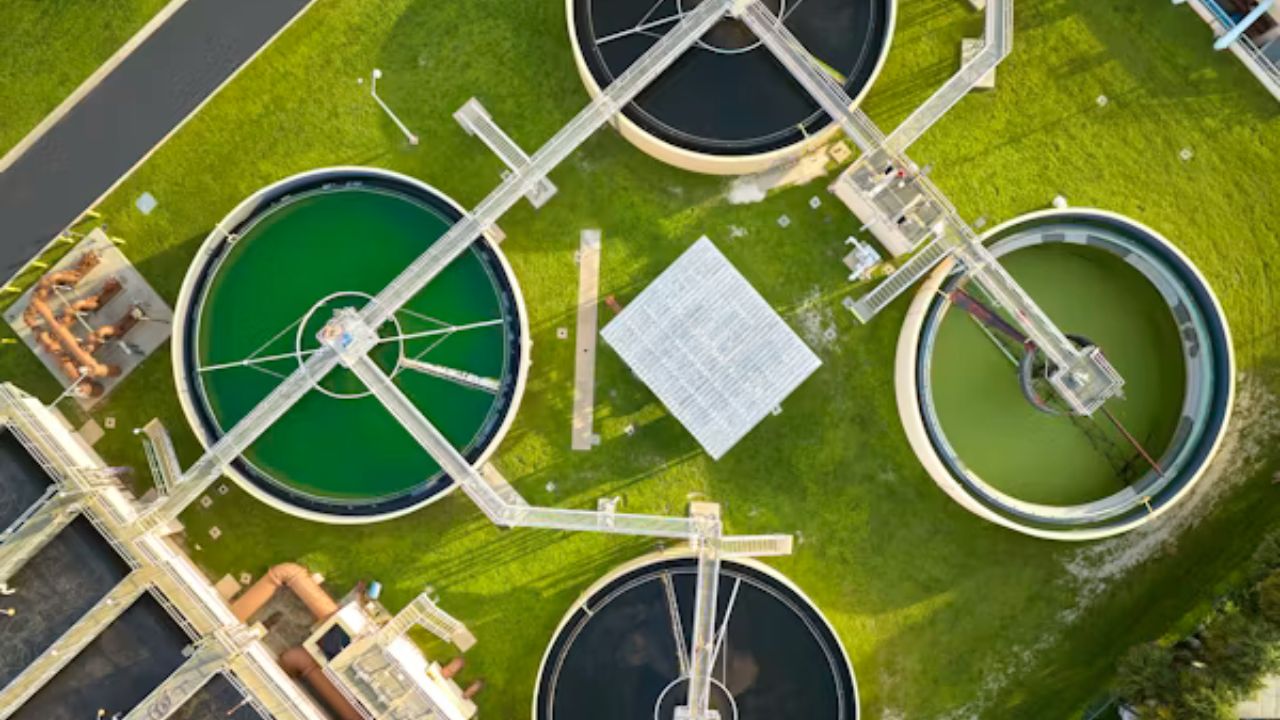
Water containing floc enters a settling basin or clarifier. Because the floc particles are heavier than the surrounding water, gravity pulls them downward.
The clearer water remains above.
This creates two streams:
- Clarified water moving forward for treatment.
- Settled solids accumulating near the bottom.
Mechanical equipment can collect settled material for removal and handling.
Why not send everything straight to the filters?
Because doing so would place an unnecessary solids load on them.
Sedimentation removes a large amount of suspended material before filtration. That can improve filter performance and extend filter runs.
This principle appears repeatedly in good treatment design:
Use each process for the contaminants it handles efficiently.
Sedimentation handles heavier aggregated particles. Filtration then deals with much finer material remaining in the clarified water.
Stage 6: Filtration Provides Another Major Barrier
After clarification, water may look clean.
Treatment isn’t finished.
The water now passes through water filtration systems designed to capture smaller particles and reduce microorganisms and other contaminants.
Traditional filters can contain layers of materials such as:
- Sand
- Gravel
- Anthracite
- Granular activated carbon
Water moves through the filter media while remaining particles become trapped or attached within the filter bed.
The CDC notes that filtration can help remove parasites, bacteria, viruses, dust and chemicals, depending on the filtration system being used.
Rapid Sand Filtration
Rapid sand filtration is widely associated with conventional municipal treatment.
Water passes relatively quickly through engineered filter media. As solids accumulate, the filter’s resistance increases.
Eventually, it needs cleaning.
Backwashing
Filters don’t last indefinitely without maintenance.
During filter backwashing, the normal water flow is reversed or otherwise altered to dislodge accumulated material from the filter bed.
The dirty backwash water is collected for appropriate treatment, recycling, or disposal according to plant design and regulations.
Backwashing allows the filter to return to effective operating conditions.
Granular Activated Carbon
Granular activated carbon (GAC) can be used when plants need greater control of certain organic compounds, taste, and odor.
Activated carbon contains an enormous internal surface area. Rather than working only like a screen, it can capture compounds through adsorption.
That makes carbon useful for water-quality challenges that conventional particle removal alone may not solve.
Stage 7: Advanced Filtration When Conventional Treatment Isn’t Enough
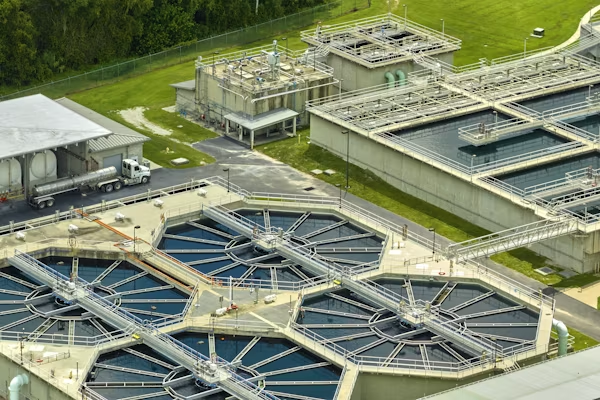
Not every plant stops with sand or granular media filtration.
The contaminant problem determines the technology.
Ultrafiltration
Ultrafiltration uses membranes with extremely small pores.
Water is driven through the membrane while larger substances are retained.
Membrane systems can create an effective physical barrier against many suspended contaminants and microorganisms.
Reverse Osmosis
Reverse osmosis (RO) goes much further.
Pressure pushes water through a semipermeable membrane that separates water from many dissolved substances.
RO is particularly useful for:
- Desalination
- Brackish-water treatment
- Advanced water reuse
- Certain dissolved-contaminant problems
But reverse osmosis has trade-offs.
It requires pressure and therefore energy. It also produces a concentrated reject stream that needs appropriate management.
For that reason, installing RO everywhere would make little engineering sense. Treatment plants choose technologies according to the water-quality challenge they actually need to solve.
Stage 8: Disinfection Controls Disease-Causing Microorganisms
After particle removal and filtration comes one of the most important public-health barriers: water disinfection.
The goal is to inactivate harmful microorganisms that may remain.
Common disinfectants and disinfection technologies include:
- Chlorine
- Chloramine
- Chlorine dioxide
- Ultraviolet light
- Ozone
Chlorination
Chlorination has an important advantage: chlorine can provide a disinfectant residual.
That means some disinfecting capacity can remain in the water as it travels through pipes.
This matters because treatment doesn’t end emotionally or practically at the plant gate. Water may spend hours or longer moving through reservoirs, mains and smaller pipes before reaching a customer.
Maintaining water quality throughout that journey is essential.
UV Disinfection
Ultraviolet disinfection uses UV energy to inactivate microorganisms.
One major difference from chlorine is that UV does not normally provide a lasting disinfectant residual throughout the distribution system.
Plants therefore design disinfection around the entire system rather than choosing technologies based on one feature.
Ozone
Ozone treatment is another powerful oxidation and disinfection process.
It can help control microorganisms and certain taste, odor, color or organic-compound problems.
Like UV, however, ozone does not provide the same persistent distribution-system residual associated with chlorine or chloramine.
Stage 9: pH and Corrosion Control
Producing microbiologically safe water is only part of the job.
Finished water must also be chemically stable enough for distribution.
Plants may adjust water pH and chemistry to reduce corrosion problems.
This matters because water interacts with pipes, fittings and plumbing materials after leaving the plant.
Poorly controlled corrosive water can contribute to deterioration of infrastructure and may increase the release of certain metals from plumbing.
Treatment engineers therefore consider the chemistry of both the source water and distribution network.
This is one of the biggest gaps in simplistic explanations of how water treatment plant works: the process doesn’t stop when water becomes visibly clear.
The finished water must remain suitable as it moves through infrastructure.
Stage 10: Water Quality Testing and Continuous Monitoring
A modern plant cannot determine safety by looking at the water.
Water quality testing is built into the process.
Operators may monitor parameters at several stages—from source water to finished water.
Depending on the plant and regulatory requirements, testing may include:
- Turbidity
- pH
- Disinfectant residual
- Temperature
- Conductivity
- Microbial indicators
- Organic and inorganic contaminants
- Treatment-process performance
Some measurements can be monitored continuously by online instruments. Others require laboratory sampling and analysis.
In the United States, EPA’s National Primary Drinking Water Regulations establish legally enforceable requirements for public water systems. EPA states that federal drinking-water rules regulate more than 90 contaminants.
Testing has two purposes.
First, it verifies finished-water quality.
Second, it tells operators whether each treatment barrier is functioning correctly.
That second role is easy to underestimate.
Operators don’t want to discover a problem only after final testing. They watch the treatment process itself so problems can be identified much earlier.
Stage 11: Clearwell and Treated Water Storage
Once treated and disinfected, water often enters a clearwell or other finished-water storage structure.
Storage serves several purposes.
It can provide:
- Disinfection contact time
- Operational buffering
- Supply during changing demand
- Reserve capacity
- More stable plant operation
Water demand isn’t constant.
A city may use relatively little water overnight, then experience a sharp increase when people wake, shower, prepare food, clean and begin commercial activities.
Treatment plants and storage facilities help balance these changing demand patterns.
Stage 12: Distribution to Homes and Businesses
The final stage is the water distribution system.
Pumps, storage tanks, reservoirs, valves, pressure zones and water mains move finished water toward consumers.
Large transmission mains feed progressively smaller pipes until water reaches individual service connections.
Distribution is more than transportation.
Utilities must manage:
- Pressure
- Storage
- Disinfectant residual
- Water age
- Leakage
- Pipe integrity
- Cross-connection risks
- Main breaks
- Sampling
A perfectly operated treatment plant cannot by itself guarantee good tap water if the distribution network is poorly managed.
That is why drinking-water safety is better viewed as a complete system:
Watershed → source → treatment plant → storage → distribution → building plumbing → tap
Complete Water Treatment Process at a Glance
| Treatment Stage | Main Purpose | What Happens |
|---|---|---|
| Source intake | Collect raw water | Water enters from river, lake, reservoir or groundwater source |
| Screening | Remove large objects | Screens catch leaves, sticks and debris |
| Coagulation | Destabilize particles | Coagulants prepare tiny particles for removal |
| Flocculation | Build larger flocs | Gentle mixing causes particles to combine |
| Sedimentation | Remove heavier solids | Flocs settle by gravity |
| Filtration | Remove finer contaminants | Water passes through granular media or membranes |
| Disinfection | Control microorganisms | Chlorine, UV, ozone or other processes are used |
| Chemistry adjustment | Protect water and infrastructure | pH and other chemistry may be adjusted |
| Testing | Verify performance and quality | Sensors and laboratories monitor water |
| Storage | Balance supply and demand | Finished water enters clearwells or reservoirs |
| Distribution | Deliver water | Pipes and pumps carry water to customers |
This sequence gives the clearest short explanation of how drinking water is treated in a conventional municipal system.
What Chemicals Are Used in Water Treatment Plants?
The phrase water treatment chemicals can sound alarming without context.
Chemicals are used because specific chemical reactions help separate contaminants, control microorganisms, adjust chemistry or protect infrastructure.
Depending on the plant, treatment chemicals may include substances used for:
Coagulation: Aluminum- or iron-based coagulants can help suspended particles form removable floc.
Disinfection: Chlorine and related disinfectants can control microorganisms.
pH adjustment: Acids, bases or other conditioning chemicals may be used to maintain suitable water chemistry.
Corrosion control: Treatment may be applied to help reduce undesirable interactions between water and distribution plumbing.
A plant does not simply pour chemicals into water according to a fixed recipe.
Doses are carefully controlled and linked to source-water characteristics, treatment goals, process monitoring and applicable standards.
Why Doesn’t Every Water Plant Use the Same Process?
This question gets to the heart of water-treatment engineering.
Imagine two utilities.
Plant A draws relatively stable groundwater from a protected aquifer.
Plant B takes water from a river affected by seasonal storms, sediment, algae and agricultural activity.
Giving both plants exactly the same treatment system would be inefficient and potentially ineffective.
Treatment selection is influenced by:
- Source type
- Contaminant profile
- Turbidity
- Hardness
- Salinity
- Natural organic matter
- Microbiological risk
- Seasonal variation
- Local regulations
- Required plant capacity
- Available space
- Energy cost
- Waste handling
- Existing infrastructure
The best plant isn’t necessarily the one containing the most equipment.
It is the plant with the correct combination of barriers for its specific water.
Conventional Treatment vs. Membrane Treatment
| Factor | Conventional Treatment | Membrane Treatment |
|---|---|---|
| Common technologies | Coagulation, clarification, media filtration | Microfiltration, ultrafiltration, reverse osmosis |
| Suspended solids | Effective | Effective |
| Dissolved salts | Limited removal | RO can remove many |
| Pressure requirement | Generally lower | Can be significantly higher |
| Typical application | Surface-water treatment | Advanced treatment, reuse, desalination |
| Residual stream | Sludge/backwash water | Backwash and/or membrane concentrate |
| Complexity | Established process | Requires specialized membrane operation |
Neither approach automatically wins.
A conventional plant may be the best solution for one community, while membrane technology is necessary for another.
What Happens to the Sludge Removed From Water?
Clean water isn’t the only output from a treatment plant.
Coagulation and sedimentation transfer contaminants from the water into a concentrated solids stream.
This creates water treatment residuals, often called sludge.
Plants must manage those residuals properly.
The exact system can include:
- Sludge collection
- Thickening
- Dewatering
- Residual-water recovery
- Transport
- Approved disposal or beneficial management where appropriate
Backwashing filters also creates a waste stream containing material removed from the filter.
This leads to an important engineering insight:
Water treatment doesn’t make contaminants disappear.
Many treatment processes separate or concentrate them so they can be handled safely.
That mass-balance perspective is often missing from basic explanations.
How Automated Is a Modern Water Treatment Plant?
Modern facilities can be highly automated, but trained operators remain essential.
Plants commonly use instrumentation and control systems to monitor:
- Flow rates
- Tank levels
- Pump status
- Chemical dosing
- Turbidity
- pH
- Disinfectant levels
- Pressure
- Filter performance
- Alarm conditions
A SCADA system, short for Supervisory Control and Data Acquisition, can give operators a centralized view of equipment and process conditions.
Automation can react quickly to measurable changes.
Human operators still provide judgment.
An instrument might report rising turbidity, for example, but operators must determine why it changed, whether an instrument needs verification, how the treatment process should respond, and whether other parameters are also shifting.
Water treatment is therefore a combination of chemistry, microbiology, hydraulics, mechanical engineering, electrical systems, instrumentation and human expertise.
What Happens During Heavy Rain or Flooding?
Storms demonstrate why treatment plants need flexibility.
Heavy rainfall can wash soil, organic material and contaminants into rivers and reservoirs.
Raw-water turbidity can rise quickly.
A plant may respond by:
- Increasing source-water monitoring
- Optimizing coagulation
- Adjusting chemical doses
- Watching floc formation
- Monitoring clarifier performance
- Shortening filter runs
- Increasing filter monitoring
- Conducting additional water-quality checks
Plants are designed around expected operating ranges, but extreme events can challenge those assumptions.
Source-water protection is therefore just as important as treatment.
Preventing contamination from entering a watershed can sometimes be more effective than trying to remove it later.
Does Water Treatment Remove Every Contaminant?
No treatment technology removes absolutely everything under every condition.
That is why engineers talk about treatment goals, contaminant-specific removal, monitoring and multiple barriers.
Conventional treatment is very effective for many particle and microbial problems but isn’t designed to remove every dissolved compound.
Activated carbon may be selected for certain organic contaminants.
Ion exchange can target particular dissolved ions.
Reverse osmosis can remove a broad range of dissolved substances.
Advanced oxidation may address difficult organic compounds.
The correct question is therefore not:
“Does this filter remove everything?”
A better question is:
“Which contaminants need to be controlled, and which treatment barriers reliably control them?”
That shift in thinking is fundamental to understanding professional water treatment.
Emerging Contaminants and Modern Treatment Challenges
Today’s utilities face challenges that older plants were not necessarily designed around.
These can include:
- PFAS
- Harmful algal blooms
- Changing source-water quality
- Saltwater intrusion
- Drought
- Aging infrastructure
- Increased water reuse
- Energy costs
- Extreme weather
Some contaminants may require treatment beyond conventional coagulation, sedimentation and filtration.
That is pushing utilities toward combinations involving activated carbon, ion exchange, membranes and other advanced processes where appropriate.
Treatment technology will continue changing, but the basic engineering principle remains the same: identify the hazard, select effective barriers, verify their performance, and monitor the finished water.
How Water Treatment Plants Protect Against Microorganisms
Microbial control demonstrates why treatment plants use multiple barriers instead of relying exclusively on chlorine.
Particle-removal stages can physically remove material associated with microorganisms.
Filtration provides another barrier.
Disinfection then inactivates remaining organisms.
This layered approach matters because microorganisms differ in their resistance to treatment.
The broader lesson is simple:
Physical removal plus effective disinfection provides greater protection than relying on a single process.
This is one reason coagulation, flocculation, sedimentation, filtration and disinfection are so closely connected in conventional treatment.
Each stage prepares water for the next.
Water Treatment and Public Health
A treatment plant is ultimately public-health infrastructure.
Its pumps and tanks are visible pieces of equipment, but the real product is risk reduction.
Unsafe water can carry microorganisms and contaminants capable of causing illness. WHO has identified microbial contamination from feces as a major drinking-water risk globally.
This explains why disinfection became such an important development in municipal water systems.
It also explains why treatment regulations focus on both contaminant levels and treatment performance.
The goal isn’t attractive-looking water.
The goal is consistently safe water.
Real-World Example: Following One Drop Through a Plant
Imagine a drop of rain landing in a watershed.
It flows across the ground and eventually reaches a reservoir.
At the reservoir, it becomes part of the utility’s raw-water supply.
An intake draws that water toward the treatment facility.
First, screening prevents large debris from continuing through the system.
Then the water enters coagulation, where chemical conditions are adjusted so tiny particles become easier to remove.
Gentle flocculation encourages those particles to form larger flocs.
The flocs settle in a clarifier.
The clearer water above them moves into filters.
Fine particles are captured.
Disinfection provides another barrier against microorganisms.
The water’s chemistry may then be adjusted for distribution.
Instruments and laboratory tests verify treatment performance.
Finished water enters storage.
Eventually pumps and gravity push it into the distribution network.
It travels through mains beneath streets, enters a service connection and reaches a kitchen faucet.
That journey is the practical answer to how water treatment plant works.
What looks like one process is actually a chain of carefully coordinated barriers.
Common Myths About Water Treatment Plants
Myth 1: Clear Water Is Safe Water
Not necessarily.
Many microorganisms and dissolved contaminants are invisible.
Appearance alone cannot establish safety.
Myth 2: Water Is Cleaned by One Giant Filter
Municipal plants normally rely on several treatment processes.
Filtration is only one part.
Myth 3: Chlorine Removes Everything
Disinfectants target microorganisms. They do not automatically remove every chemical contaminant.
Myth 4: Treatment Ends at the Plant
Water quality must also be protected during storage and distribution.
Myth 5: More Treatment Is Always Better
Treatment must match the problem.
Unnecessary processes increase cost, energy use, maintenance and residual production without necessarily providing meaningful benefit.
How Much Water Can a Treatment Plant Process?
Plant capacity varies enormously.
A small community facility may serve a relatively limited population, while a major metropolitan plant can treat vast quantities of water every day.
Engineers generally size systems based on more than average consumption.
They consider:
- Average daily demand
- Peak demand
- Population growth
- Industrial demand
- Fire-flow requirements
- Storage capacity
- Redundancy
- Maintenance downtime
- Seasonal use
A plant needs enough capacity to cope with high-demand conditions without compromising treatment quality.
How Long Does Water Treatment Take?
There isn’t one universal number.
Treatment time depends on:
- Plant design
- Flow rate
- Source-water quality
- Clarification technology
- Filter configuration
- Required disinfectant contact time
- Storage design
Some processes happen quickly.
Rapid mixing during coagulation can occur over a relatively short period, while flocculation, settling, filtration and disinfection each add hydraulic residence time.
Rather than focusing only on total hours, engineers evaluate whether each process receives enough time and the correct operating conditions to accomplish its treatment objective.
What Makes a Water Treatment Plant Reliable?
A good plant is designed for failure—not because engineers expect poor performance, but because critical infrastructure cannot depend on everything working perfectly forever.
Reliability measures can include:
- Backup pumps
- Multiple filters
- Standby power
- Chemical-storage reserves
- Duplicate instruments
- Emergency response procedures
- Preventive maintenance
- Operator training
- Multiple treatment barriers
If one filter needs maintenance, the entire community shouldn’t lose its drinking-water supply.
That idea is called redundancy.
It is one of the less visible but most important principles in infrastructure design.
Source Water Protection: The Treatment Step Before Treatment
The cheapest contaminant to remove can be the one that never enters the water source.
Utilities and communities therefore pay attention to source water protection.
Protecting watersheds and aquifers can reduce risks from:
- Waste disposal
- Agricultural runoff
- Industrial releases
- Sewage contamination
- Erosion
- Chemical spills
Treatment plants provide powerful protection, but they should not be treated as an excuse to pollute water sources.
Good water management combines prevention and treatment.
Water Reuse Is Changing the Traditional Water Cycle
Historically, cities often treated drinking water, used it once, treated the wastewater, and discharged it.
Water scarcity is encouraging a more circular approach.
Water reuse means treating water so it can serve another beneficial purpose.
Recycled water may be used for:
- Irrigation
- Industrial processes
- Street cleaning
- Toilet flushing
- Environmental purposes
- Groundwater recharge
- Drinking-water supply after appropriate advanced treatment
The EPA describes potable reuse as highly treated recycled water used for drinking-water purposes.
Advanced potable-reuse systems may combine multiple technologies, including membrane filtration, reverse osmosis, advanced oxidation and further drinking-water treatment depending on system design.
The key concept is fit-for-purpose treatment.
Water should receive the level of treatment required for its intended use.
Practical Questions to Ask About Your Local Drinking Water
Consumers don’t need to become treatment engineers, but asking the right questions can make local water information much easier to understand.
Useful questions include:
- Where does our drinking water originate?
- Is it surface water or groundwater?
- Which treatment processes does the utility use?
- What disinfectant is used?
- How is finished water tested?
- Which contaminants are routinely monitored?
- What does the latest consumer water-quality report show?
- Are there current advisories affecting the supply?
Those questions provide far more useful information than simply asking whether municipal water is “filtered.”
Featured Snippet: What Are the 7 Main Steps of Water Treatment?
The main steps in conventional drinking-water treatment are:
- Intake and screening – collect raw water and remove large debris.
- Coagulation – destabilize microscopic suspended particles.
- Flocculation – combine particles into larger flocs.
- Sedimentation – allow heavy flocs to settle.
- Filtration – remove smaller particles and microorganisms.
- Disinfection – inactivate remaining disease-causing microorganisms.
- Storage and distribution – protect and deliver treated water to consumers.
Some facilities include extra processes such as activated carbon adsorption, membrane filtration, reverse osmosis, softening, oxidation or corrosion control.
Key Takeaway
Understanding how drinking water is treated becomes much easier once you stop thinking about a water plant as a single purifier.
It is a sequence of barriers.
Coagulation prepares particles for removal. Flocculation builds those particles into larger clusters. Sedimentation separates them with gravity. Water filtration systems catch material that remains. Water disinfection controls microorganisms. Chemistry adjustment helps protect infrastructure, and water quality testing confirms that treatment is performing as intended.
Technologies such as rapid sand filtration, granular activated carbon (GAC), ultrafiltration, reverse osmosis (RO), UV disinfection, ozone treatment, and chlorination can be selected according to the specific source-water challenge.
The engineering isn’t about making water look clean. It is about repeatedly reducing risk until the finished supply meets the standards established for safe drinking water.
That is the real story behind every ordinary glass filled from a municipal tap.
Frequently Asked Questions
How does a water treatment plant work step by step?
A plant collects source water, screens out large debris, uses coagulation and flocculation to gather small particles, removes floc through sedimentation, filters the clarified water, disinfects it, checks its quality, stores it, and sends it into the water distribution system. Advanced plants may add membranes, activated carbon or other technologies.
What are the five basic water treatment steps?
The five processes most commonly used to explain conventional treatment are coagulation, flocculation, sedimentation, filtration and disinfection. The CDC describes these as common treatment steps, although individual utilities may use different combinations based on source-water quality.
What is the purpose of coagulation in water treatment?
Coagulation changes the behavior of tiny suspended particles that otherwise remain dispersed in water. After treatment with an appropriate coagulant, the particles can combine during flocculation and become easier to remove.
What happens during flocculation?
During flocculation, water is gently mixed so destabilized particles collide and form larger clusters known as flocs. Those heavier particles can then settle during clarification.
What is sedimentation in a water treatment plant?
Sedimentation uses gravity to separate floc from water. Heavier solids settle near the bottom of a clarifier while clearer water moves forward to filtration.
How does filtration clean drinking water?
Filters pass water through engineered media or membranes. Depending on the technology, filtration can remove suspended particles, microorganisms and some chemicals. Conventional media may include sand, gravel, anthracite or activated carbon.
Why is chlorine added to drinking water?
Chlorination is used to control harmful microorganisms. A useful feature of chlorine-based treatment is the ability to maintain a disinfectant residual that helps protect water while it moves through distribution pipes.
Does a water treatment plant remove salt?
Conventional treatment is not intended to remove large quantities of dissolved salt. Reverse osmosis (RO) and other desalination technologies are commonly needed when salt removal is required.
Is reverse osmosis used by municipal water plants?
Yes, in appropriate applications. Reverse osmosis (RO) is particularly useful for desalination, brackish water, advanced reuse and certain dissolved contaminants. Many conventional freshwater plants do not need it.
Is UV used in drinking-water treatment?
Yes. UV disinfection can inactivate microorganisms without adding a chemical disinfectant at the UV treatment point. Because UV does not normally provide a lasting residual in distribution pipes, system-wide disinfection strategy still needs careful consideration.
What does activated carbon do in water treatment?
Granular activated carbon (GAC) can adsorb certain organic compounds and help control undesirable taste and odor. Its usefulness depends on the contaminant and system design.
What is the difference between drinking-water and wastewater treatment?
A drinking water treatment plant treats source water so it can be supplied for drinking and domestic purposes. Wastewater plants treat used water and sewage so the resulting water can be discharged or reused according to applicable requirements.
How is treated water tested?
Water quality testing combines process monitoring, online instruments, sampling and laboratory analysis. Utilities monitor different parameters according to their treatment systems and regulatory requirements.
Can treated wastewater become drinking water?
Yes, when an appropriately designed system provides the advanced treatment and safeguards required for potable reuse. Water reuse systems can use multiple treatment barriers before recycled water becomes part of a drinking-water supply.
Why do water treatment plants use several treatment stages?
Different contaminants behave differently. One technology cannot efficiently solve every problem. Multiple treatment barriers provide better control and allow one process to support the next.