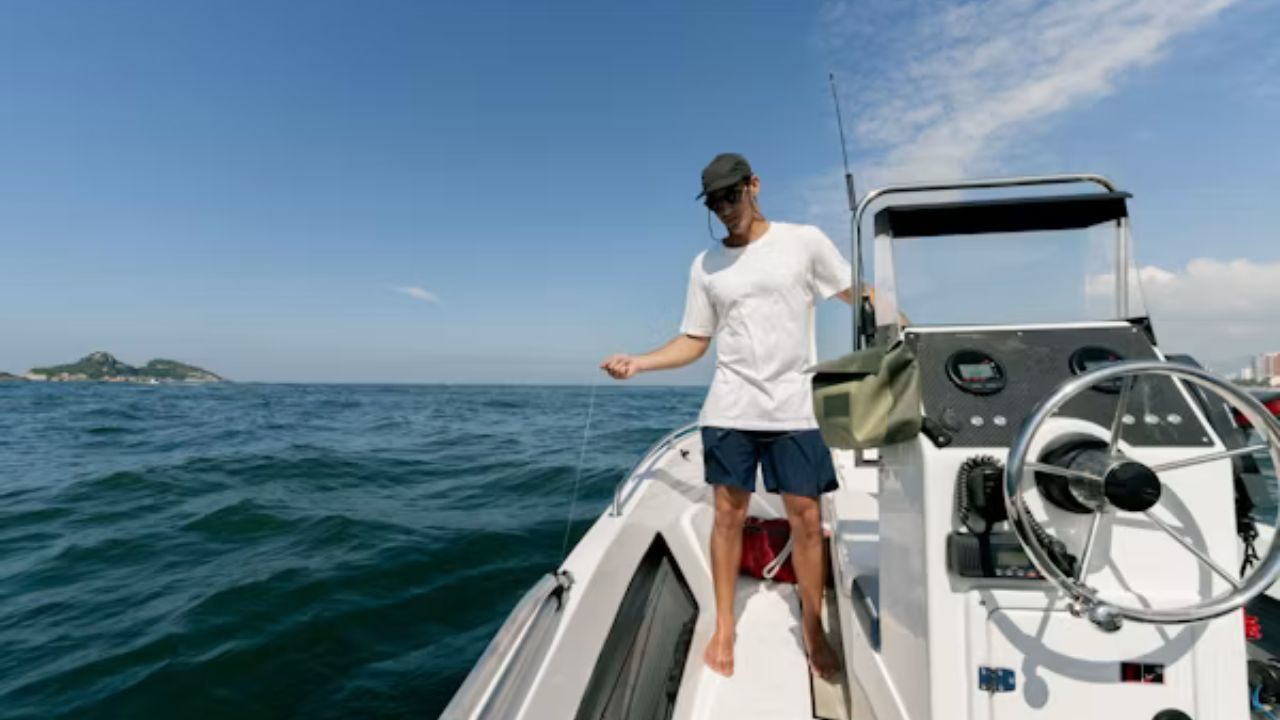
A day on the water can change quickly. Someone loses balance, the operator is thrown away from the helm, or a passenger unexpectedly enters the water. On a powered boat, one of the greatest immediate hazards in those situations is an engine that continues running while nobody is properly controlling the vessel. Boat Equipment That Helps Prevent Propeller Strike Injuries.
That leads to an important boating-safety question: what piece of equipment on a boat is most important in preventing propeller strike injuries?
For most recreational powerboats, the best answer is the engine cut-off switch (ECOS), used with its engine cut-off switch link or lanyard.
The device is sometimes called an emergency engine cut-off switch, kill switch, ignition cut-off switch, engine safety switch, or engine stop switch. The terminology varies, but the basic safety purpose is the same: if the operator is unexpectedly separated from the controls, the system shuts down the propulsion engine.
That simple action can prevent a powered boat from continuing uncontrolled and can stop the propeller from remaining under engine power.
The U.S. Coast Guard identifies engine cut-off switches as an important tool for preventing accidents, injuries, and deaths associated with operators being unexpectedly displaced from the helm. When an operator goes overboard, an uncontrolled vessel may continue moving or begin circling, putting the operator and other people in the water at risk.
Propeller guards, warning systems, interlocks, sensors, ringed propellers, and other technologies can also play valuable roles. None of that changes the fundamental lesson: propeller safety works best as a system involving equipment, responsible operation, passenger management, awareness, and established procedures around swimmers.
Quick Answer: What Equipment Is Most Important?
An engine cut-off switch (ECOS) with an attached lanyard or wireless link is one of the most important pieces of equipment for preventing propeller-related injuries on recreational motorboats.
The switch is designed to shut down propulsion when the boat operator moves far enough away from the helm to activate the system.
A traditional setup generally uses a physical lanyard connected between the operator and the engine cut-off switch. Wireless systems may use an electronic device carried by the operator.
The safety principle is straightforward:
Operator separated from controls → ECOS activates → engine shuts down → powered propeller rotation stops.
The U.S. Coast Guard explains that shutting down the engine after an operator is ejected can help prevent contact with the vessel’s spinning propeller and can prevent the boat from becoming an uncontrolled runaway vessel.
That makes the engine cut-off system particularly important because it addresses the propulsion source rather than simply placing a barrier around the propeller.
Why Propeller Strike Prevention Matters
A boat propeller is designed to transfer engine power into thrust. That makes it highly effective at moving a vessel through water, but it also means an operating propeller presents a serious hazard to anyone nearby.
People can enter the water unexpectedly for many reasons:
- An operator or passenger can fall overboard.
- A swimmer may approach a boat.
- Someone may be boarding from a swim platform.
- A watersports participant may be near the stern.
- A passenger may lose balance after sudden acceleration or turning.
- Another person in the water may be difficult to see from the helm.
Visibility is one of the underestimated problems.
Water glare, waves, passengers, the boat’s structure, distance, and operator position can make a person surprisingly difficult to see. The Coast Guard therefore advises boat operators to remain aware of people in the water, account for passengers before starting the engine, establish rules for swim-platform and boarding-ladder use, and take extra precautions around towed watersports.
Equipment is important, but awareness remains part of the protection system.
What Is an Engine Cut-Off Switch?
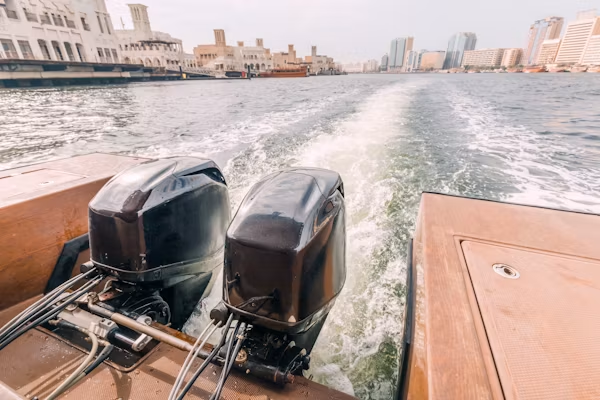
An Engine Cut-Off Switch, abbreviated ECOS, is a safety mechanism that shuts down a boat’s propulsion machinery when the operator is unexpectedly displaced from the helm.
The associated Engine Cut-Off Switch Link, or ECOSL, connects the operator to that system.
According to U.S. Coast Guard guidance, a link can be attached to the operator, the operator’s clothing, or a personal flotation device. Traditional versions are often coiled lanyards. Electronic or wireless systems are another option.
The concept is not complicated, and that is part of its strength.
If the operator remains where they are supposed to be, the boat operates normally. If an unexpected event separates the operator from the helm far enough to trigger the system, the propulsion engine shuts down.
Traditional Lanyard Systems
A conventional system uses a physical connection between the operator and the cut-off switch.
The system is intentionally simple. Separation from the controls disengages the link and stops the engine.
Traditional lanyards remain common because they provide a direct physical connection and make it easy for an operator to see whether the system is attached.
Wireless Engine Cut-Off Systems
Wireless systems remove the physical cord between the operator and helm.
Instead, an electronic device communicates with the vessel’s cut-off system. The specific operating method depends on the system and manufacturer.
Wireless systems can be convenient where operators need greater freedom of movement, but convenience should never replace correct use. A safety device that is present but not properly used cannot provide its intended protection.
Why an Engine Cut-Off Switch Helps Prevent Propeller Strikes
The biggest benefit becomes obvious when you imagine what happens without one.
Suppose an operator is unexpectedly thrown overboard while the engine remains running.
The boat may continue moving.
Depending on steering position, speed, vessel design, and other factors, an unmanned boat can potentially begin circling. The person who was thrown overboard may then find themselves in the path of their own vessel.
The Coast Guard specifically warns about this runaway-vessel scenario. An uncontrolled boat can endanger the ejected operator, passengers, other boaters, people in the water, and responders attempting to stop it.
The ECOS interrupts that chain of events.
Instead of allowing propulsion to continue after the operator is separated from the controls, it shuts the engine down.
Think of It as Breaking the Accident Chain
Many boating incidents involve a sequence rather than one isolated mistake.
For example:
Operator loses balance
↓
Operator leaves helm
↓
Boat continues under power
↓
No one controls steering or throttle
↓
Boat moves unpredictably
↓
People in the water face increased risk
An engine cut-off switch intervenes near the beginning of that sequence.
Operator leaves helm
↓
Engine cut-off system activates
↓
Propulsion shuts down
Preventing an incident early in the chain is usually much more effective than trying to manage an uncontrolled vessel after the situation has developed.
Engine Cut-Off Switch vs. Propeller Guard
People frequently assume that a propeller guard must be the most important answer because the guard is physically located around the propeller.
Propeller guards can be useful safety devices, but the two technologies address different parts of the problem.
| Safety Equipment | Primary Purpose | Main Safety Role |
|---|---|---|
| Engine cut-off switch | Stops propulsion when operator is displaced | Helps prevent runaway powered vessels |
| ECOS lanyard/link | Connects operator to cut-off system | Activates engine shutdown after separation |
| Wireless ECOS | Electronic operator-to-engine connection | Provides automatic shutdown without a traditional cord |
| Propeller guard | Creates a physical structure around the propeller | May reduce direct contact in suitable applications |
| Interlock system | Restricts operation under specified conditions | Adds another control layer |
| Warning labels | Identifies hazardous areas | Improves passenger awareness |
| Personal flotation device | Helps keep a person afloat | Important overboard protection, but does not stop the propeller |
The Coast Guard recognizes several propeller-safety technologies, including wireless cut-off switches, propeller guards, ringed propellers, interlocks, sensors, anti-feedback steering, and alternative propulsion approaches. It recommends reviewing suitable options with a marine professional because not every device is appropriate for every vessel.
This is why the question should not be interpreted as meaning that every boat needs the same propeller guard.
Boat type, propulsion system, intended operation, manufacturer specifications, and applicable regulations all matter.
The Engine Cut-Off Switch Link Matters Just as Much as the Switch
Having an ECOS installed is only half the story.
The link must be used correctly for the system to protect an operator who is separated from the helm.
Imagine having a seat belt installed in a car but never wearing it. The safety technology exists, but it cannot perform its intended function at the moment it is needed.
An ECOS link works on the same principle.
The Coast Guard states that the link may connect to the operator, clothing, or personal flotation device. When separation causes the link to disengage, the engine shuts down.
A wireless system follows a different technical process but serves a similar safety purpose.
The important takeaway is not simply:
“My boat has a cut-off switch.”
The meaningful safety question is:
“Is the system functional and being used as intended?”
Understanding the U.S. Engine Cut-Off Switch Requirement
Federal requirements are another reason recreational boaters should understand ECOS systems.
Under U.S. federal rules described by the Coast Guard, operators of covered recreational vessels must use an engine cut-off switch link while operating on plane or above displacement speed when the applicable conditions are met.
A covered recreational vessel is generally a recreational vessel:
- Less than 26 feet in length; and
- Capable of developing at least the specified level of static thrust, roughly corresponding to about 3 horsepower.
The federal use requirement became effective April 1, 2021. Certain exceptions apply, including vessels where the primary helm is located inside an enclosed cabin.
Requirements can vary with vessel configuration, operation, jurisdiction, and other factors, so operators should check current regulations applicable to their boat and location rather than relying solely on a general article.
When Does an ECOS Need to Be Used?
Under the federal U.S. requirement described by the Coast Guard, operators of covered recreational vessels use the engine cut-off switch link while operating on plane or above displacement speed.
The Coast Guard FAQ explains that the link does not have to remain attached during certain low-speed activities such as idling or docking maneuvers.
The distinction matters because boating involves very different operating conditions.
Moving slowly toward a dock is different from traveling at planing speed across open water.
Rather than trying to memorize one sentence and apply it everywhere, operators should know their vessel, understand their installed equipment, read the manufacturer’s instructions, and follow current local and federal requirements.
Propeller Guards Still Have an Important Role
Giving the ECOS top priority does not mean propeller guards should be dismissed.
A propeller guard is designed to create a physical barrier or structure around an exposed propeller. Depending on the design and application, that may help reduce the chance of direct contact.
The U.S. Coast Guard has developed a propeller-guard test procedure, through work associated with the American Boat and Yacht Council, to provide a consistent approach for evaluating these products.
But there is an important practical distinction.
A propeller guard addresses the contact point.
An ECOS addresses the continued propulsion of the vessel after control is lost.
Those are related but different hazards.
This distinction explains why good boating safety should be layered rather than dependent on one device.
The Best Propeller Safety Strategy Uses Multiple Layers
Safety professionals rarely rely on a single protective measure when several independent layers can reduce risk.
The same idea works on a boat.
Layer 1: Prevent People From Entering the Water Unexpectedly
Safe seating and responsible passenger behavior come first.
Passengers should use designated seating positions rather than sitting in locations where they could easily fall overboard.
Layer 2: Stop Propulsion if the Operator Is Displaced
This is where the engine cut-off switch becomes especially valuable.
If control is unexpectedly lost, the system can shut down propulsion.
Layer 3: Keep People Away From Propeller Hazard Areas
Passengers need clear rules about swimming, boarding, watersports, and approaching the stern.
Layer 4: Use Suitable Protective Technology
Depending on the vessel, propeller guards, interlocks, sensors, or other manufacturer-approved technologies may provide another layer.
Layer 5: Maintain Situational Awareness
The operator should know where passengers and nearby swimmers are before operating the propulsion system.
The Coast Guard emphasizes accounting for passengers before starting an engine and maintaining awareness of people in the water.
No single layer should become an excuse for ignoring the others.
Why the Operator Is Still the Most Important Part of the Safety System
Technology responds to conditions. People make decisions.
That difference matters.
An engine cut-off switch cannot decide that a swimmer is too close to the stern. A propeller guard cannot count passengers. A warning sticker cannot determine that someone is missing from their seat.
Those tasks belong to the operator and crew.
The Coast Guard notes that human error remains a leading cause of recreational boating accidents and emphasizes boater education as a major part of accident prevention.
A responsible operator develops habits that make dangerous situations less likely in the first place.
That includes knowing who is aboard, knowing who is in the water, communicating before starting propulsion, maintaining a proper lookout, and making sure safety equipment is functional.
Propeller Safety Around Swimmers
One of the highest-risk situations occurs when people are intentionally entering or leaving the water.
Swim platforms and boarding ladders are often located near the stern—the same general area where propulsion equipment may be located.
That means the operator should treat swimming as a distinct operating condition, not simply another part of cruising.
Everyone aboard should understand when swimming is permitted and when the boat is being prepared to move.
Clear communication matters.
People should never have to guess whether the operator knows they are in the water.
The Coast Guard recommends establishing specific rules for swim-platform use, boarding ladders, and seating positions.
A simple boat-wide safety routine can prevent confusion.
Propeller Safety During Towed Watersports
Waterskiing, wakeboarding, tubing, and similar activities naturally put people in the water near powered boats.
That makes situational awareness especially important.
A dedicated observer can help the operator maintain awareness of the person being towed while the operator concentrates on safely controlling the vessel.
The operator should also understand local regulations governing observers, towing equipment, operating areas, and watersports.
The broader lesson is simple: activities that deliberately place people in the water require more communication and awareness, not less.
Propeller Safety and Children
Children require particularly close supervision around any powered vessel.
Their movements can be unpredictable, and they may not understand which parts of a boat are hazardous.
Boat rules should therefore be explained before departure rather than after the vessel is underway.
The Coast Guard specifically advises careful supervision of children and encourages boat owners to think about “childproofing” their vessels in the same way they would identify hazards at home.
The goal is not to frighten young passengers. It is to establish simple boundaries that everyone understands.
Common Mistakes That Weaken Propeller Safety
Most safety equipment only works when people use it consistently.
Several habits can undermine an otherwise well-equipped boat.
Ignoring the Engine Cut-Off Link
An installed ECOS cannot provide its intended automatic shutdown protection if the necessary link is not being used.
Assuming Everyone Is Still Aboard
Before starting or moving the boat, the operator should account for passengers.
Depending Entirely on a Propeller Guard
A guard may be one layer of protection, but it does not replace responsible operation or an appropriate engine cut-off system.
Allowing Unsafe Seating
Passengers should remain in designated seating positions while the vessel is underway.
Treating Low Visibility as No Risk
If an operator cannot clearly see an area around the boat, that is a reason for greater caution—not an assumption that nobody is there.
Skipping Equipment Checks
Safety equipment needs maintenance.
The Coast Guard recommends checking existing ECOS systems regularly according to manufacturer instructions.
A Practical Pre-Departure Propeller Safety Check
Before leaving the dock, operators can incorporate propeller awareness into their normal safety inspection.
Check that:
- The engine cut-off system is functional.
- The ECOS link or approved wireless device is available.
- Required personal flotation devices are aboard.
- Passengers know the basic safety rules.
- Children understand where they may sit and move.
- Boarding and swim-platform procedures are clear.
- The operator knows how to shut down propulsion quickly.
- Passengers understand that the stern and propulsion area require special caution.
- The boat’s operating manual is available and its safety instructions have been reviewed.
- Any installed propeller-safety devices are maintained according to manufacturer recommendations.
This should complement—not replace—the complete pre-departure inspection appropriate for the vessel.
Engine Cut-Off Switch vs. Life Jacket: Which Is More Important?
This comparison sometimes appears in boating-safety questions, but it creates a false choice.
The devices protect against different hazards.
A properly selected personal flotation device helps a person remain afloat after entering the water.
An engine cut-off switch helps stop propulsion if the operator is unexpectedly separated from the controls.
One does not replace the other.
For an operator who is thrown overboard, both protections can become relevant at essentially the same moment.
This is a good example of layered safety: one system addresses flotation while another addresses uncontrolled propulsion.
Does an Engine Cut-Off Switch Stop the Propeller Instantly?
The ECOS shuts down the propulsion engine when activated. The mechanical components do not become motionless at the exact mathematical instant the switch activates; rotating components take time to slow.
That is one reason the device should be viewed as a risk-reduction system rather than an invisible shield.
The Coast Guard describes the shutdown as causing the propeller to slow rapidly and stop rotating.
The distinction reinforces an important principle: nobody should intentionally approach a propeller simply because an ECOS or another safety device is installed.
Does Every Boat Need a Propeller Guard?
No universal answer applies to every vessel.
Propulsion systems differ significantly.
A small outboard-powered fishing boat, sterndrive runabout, personal watercraft, inboard ski boat, and larger cruiser can have very different propulsion arrangements.
A safety product suitable for one design may not be suitable for another.
The Coast Guard’s propeller-safety materials identify several types of safety devices and recommend consulting a marine professional to determine which preventive measures are appropriate for a particular boat.
Manufacturer instructions should also be treated as a primary source for equipment compatibility.
How Boat Design Affects Propeller Risk
Propeller safety is partly an equipment issue and partly a vessel-design issue.
Relevant design characteristics include:
- Propeller location
- Outboard, inboard, or sterndrive configuration
- Swim-platform design
- Boarding-ladder location
- Visibility from the helm
- Passenger seating
- Vessel size
- Steering characteristics
- Engine configuration
- Intended recreational activity
These factors change how people interact with the propulsion area.
For example, a boat frequently used for swimming may have passengers moving between the water and stern throughout the day. A fishing boat may have passengers moving around the deck while underway. A watersports boat routinely operates near people who have intentionally entered the water.
The safety procedure should reflect the actual use of the vessel.
What Happens When a Boat Operator Falls Overboard?
The dangerous part is not simply that the operator enters the water.
The bigger problem is that the vessel may still be powered.
If nobody else immediately controls it, the boat can continue moving. Depending on its steering position and other conditions, it may move away or circle.
This creates multiple hazards simultaneously:
- The operator is now in the water.
- The vessel may have no competent person at the controls.
- The propulsion system may still be operating.
- Other passengers may be aboard an uncontrolled boat.
- Nearby swimmers and vessels may also be exposed to danger.
The engine cut-off system is designed to remove one of those hazards quickly by shutting down propulsion.
That is why its role is broader than simply “propeller protection.”
It is also runaway-vessel protection.
A Real-World Scenario
Consider a small recreational powerboat traveling at speed.
The operator encounters an unexpected movement and is displaced from the helm.
Without an ECOS link in use
The engine may continue providing propulsion even though the operator is no longer properly controlling the vessel.
The situation can rapidly become unpredictable.
With a functioning ECOS link properly used
Separation activates the engine cut-off system and shuts down propulsion.
That does not magically eliminate every danger. The operator is still in the water, passengers still need to respond appropriately, and environmental conditions still matter.
But one major hazard—the boat continuing under engine power without its operator—has been reduced.
That is the value of engineering controls: they can intervene when events move too quickly for a person to react manually.
Why Safety Equipment Should Be Tested and Maintained
Safety equipment often spends most of its life waiting.
That creates a maintenance problem people sometimes overlook.
A device may be installed for years without being activated during a real emergency. Corrosion, electrical problems, damaged components, previous modifications, or simple wear can affect equipment.
The Coast Guard recommends regular checks of ECOS systems according to manufacturer instructions.
Maintenance records can also be useful, particularly after purchasing a used boat.
If an operator does not know whether a safety system works correctly, a qualified marine technician can inspect the system.
Older Boats and Engine Cut-Off Systems
Not every older recreational vessel was manufactured under the same equipment requirements.
The Coast Guard’s FAQ explains that installation requirements depend partly on vessel manufacturing date and configuration. Older vessels may therefore differ from newer boats.
Owners should not assume that an older boat has the same equipment as a current model.
A used-boat inspection should identify:
- Whether an ECOS is installed
- Whether it functions
- Whether it has been modified
- Whether the appropriate link is available
- Whether manufacturer documentation is available
- Which current requirements apply
Where there is uncertainty, a marine professional or appropriate boating authority is a better source than guesswork.
Why Training Matters Alongside Equipment
Safety devices are most effective when the operator understands why they exist.
Someone who sees an ECOS lanyard as an inconvenience is less likely to use it consistently.
Someone who understands the runaway-vessel scenario sees the same cord differently: it is the connection that can shut down propulsion when the operator can no longer do so manually.
That is why boating education matters.
Training can cover navigation rules, passenger safety, emergency procedures, required equipment, local regulations, weather awareness, lookout responsibilities, and vessel handling.
The Coast Guard explicitly encourages boating education because operator knowledge and behavior remain major factors in accident prevention.
The Most Effective Approach: Equipment + Behavior + Awareness
There is a broader lesson hidden inside this question.
People often search for one product that will “prevent” an accident.
Real safety rarely works that way.
A better model is:
Safe equipment + trained operator + clear passenger rules + maintained vessel + situational awareness
The ECOS is important because it provides an automatic response to a specific emergency.
Propeller guards and related technologies may provide another layer.
Life jackets address the consequences of entering the water.
Training reduces poor decisions.
Passenger communication reduces confusion.
A lookout improves awareness.
Maintenance helps make sure the equipment actually works.
Put those layers together and the protection becomes much stronger than any single product could provide by itself.
Featured Snippet Answer
What piece of equipment on a boat is most important in preventing propeller strike injuries?
The engine cut-off switch (ECOS), used with its lanyard or wireless link, is one of the most important pieces of boating equipment for preventing propeller strike injuries. If the operator is displaced from the helm, the system shuts down the propulsion engine, helping prevent an uncontrolled boat from continuing under power. Propeller guards and other safety devices can provide extra protection, but they do not replace responsible operation, passenger awareness, or a properly used engine cut-off system.
Frequently Asked Questions
What is the most important equipment for preventing a propeller strike?
An engine cut-off switch with its appropriate link is a primary piece of equipment because it shuts down propulsion when the operator is unexpectedly separated from the controls. Propeller guards and other safety technologies can provide extra layers of protection.
What is another name for an engine cut-off switch?
Common terms include ECOS, emergency engine cut-off switch, ignition cut-off switch, engine safety switch, and kill switch. “Engine/Propulsion Cut-Off Device” is also used in official boating-safety information.
What does an engine cut-off switch do?
It shuts down the boat’s propulsion engine when its triggering system detects that the operator has been displaced from the helm. Traditional systems commonly use a physical lanyard, while some systems use wireless technology.
Is a propeller guard better than an engine cut-off switch?
They address different risks. A propeller guard creates a physical protective structure around the propeller, while an ECOS stops propulsion when the operator is displaced. Depending on the vessel, both may form part of a layered safety strategy.
Can an engine cut-off switch prevent a runaway boat?
That is one of its main purposes. When an operator is unexpectedly separated from the helm, shutting down propulsion can prevent the vessel from continuing under engine power without proper control.
Should passengers know where the propeller is?
Yes. Passengers should understand which areas present propulsion hazards, especially around the stern, swim platform, and boarding ladder.
Does wearing a life jacket prevent propeller strikes?
A life jacket primarily provides flotation; it does not shut down the engine or physically protect someone from a propeller. Life jackets and engine cut-off switches serve different safety purposes and should not be viewed as substitutes for one another.
Are wireless engine cut-off switches available?
Yes. The Coast Guard recognizes wireless engine cut-off technology as an alternative to traditional lanyard-style systems. Compatibility and operation depend on the vessel and equipment.
Is an engine cut-off switch required on every recreational boat?
No. Requirements depend on factors such as vessel length, propulsion capability, manufacturing date, helm configuration, and operating conditions. Current Coast Guard guidance and applicable state or local rules should be checked for a particular vessel.
Why are propeller strikes so dangerous?
A powered propeller rotates rapidly and is designed to transfer substantial engine power into the water. This makes keeping swimmers and passengers away from an operating propulsion system essential.
Should an ECOS be checked before boating?
It should be maintained and checked according to the boat and equipment manufacturer’s instructions. A marine technician can inspect a system if its condition or operation is uncertain.
What other technologies can reduce propeller-related risks?
Depending on vessel design, options may include propeller guards, ringed propellers, sensors, interlocks, wireless cut-off systems, anti-feedback steering, and alternative propulsion designs. A qualified marine professional can advise on compatibility.
Final Safety Takeaway
The question sounds as though it should have a one-word answer, but good boating safety deserves a little more context.
The engine cut-off switch (ECOS) is the strongest general answer because it tackles one of the most dangerous situations directly: an operator being separated from the controls while the boat remains powered.
A propeller guard may provide another physical layer. A life jacket helps protect someone who enters the water. Training helps prevent poor decisions. Passenger rules keep people away from dangerous areas.
None should be treated as permission to take greater risks.
The safest recreational boating environment is one where the operator understands the vessel, uses its safety equipment correctly, maintains awareness of everyone aboard and in the water, and follows the boat manufacturer’s instructions and applicable boating regulations.
That combination—not a single gadget—is what turns propeller safety from a piece of equipment into a complete prevention strategy.